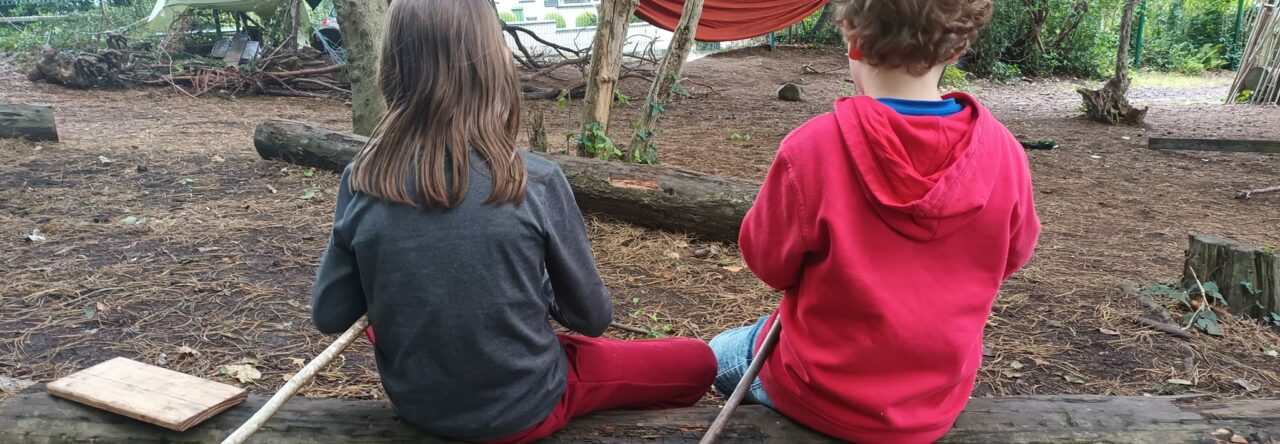
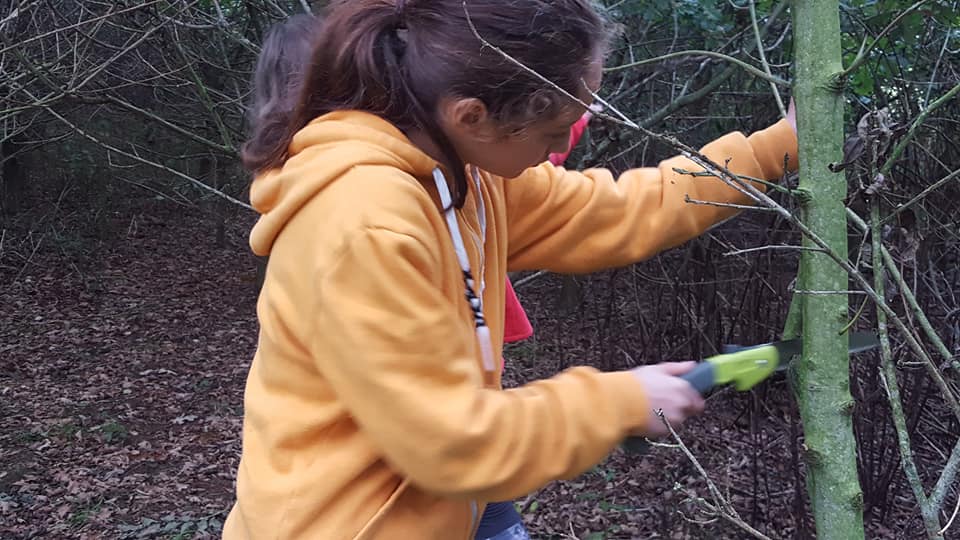
Here are some pictures from the past week – we have only been back for a week! Many friends have returned and a few more are about to join. Here are some photos from the Quarries in Bangor (Tuesdays and Saturdays) as well as Hillsbrough Forest Park (Wednesday).
Collecting tinder – the children learn that fire lives in the seedsWe light the fire using a dragon sneeze – the children learn what a precious element it is and how difficult it is to make oneIt only takes a spark, but the hard work of sparking! That’s a different story.Making spiles for tree tapping – in the future!Tree tapping equipmentPlaying amongst the bluebells in Hillsbrough – these are what memories are made ofMagic is a biiiig part of what we doPlaying on a swing in the forest!
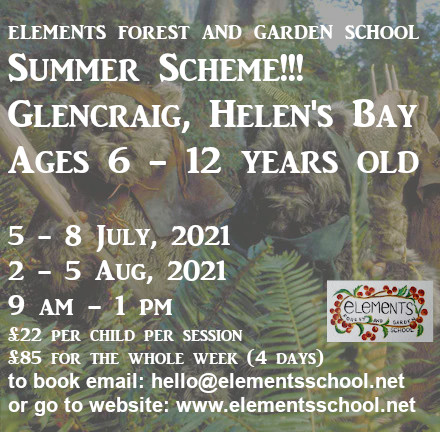
We cannot describe how excited we are!!! Our very first summer scheme which builds on the nearly 60 sessions we have done since we have started this year… and that’s not counting the scores of sessions we have had since we started doing Forest School lessons since 2013!
Our booking form will be made available soon or by email, so to book a provisional place which will be confirmed by next week please either email hello@elementsschool.net or call 07410411840 that’s Jonathan’s phone number.
With the Glencraig site we will have access to a beautiful naturally managed forest, historic walks and a blue flag beach – Helen’s Bay! There is outdoor cooking, crafts and storytelling. We will have wildlife and nature ID, and of course a deep and meaningful connection to nature.
Would you like to learn how to draw this oak? Gabriel will take you through it step by step
Drawing trees with Gabriel Knight
Saturday – June 12, 19, 26 and July 3
10 am – 11.30 pm
Cost: $20 per session, material included
Elements is very excited to announce the first ever art course run with Gabriel Knight at The Quarries in Bangor. Learn how to draw beautiful, realistic and gorgeous trees with experienced teacher Gabriel Knight.
Gabriel has taught art now for more than 30 years to children as well as adults. Her personal lessons are filled with warmth and carefully planned to ensure that participants come away with something to be satisfied with! Whether you are just beginning or have done this for a while, it is the right class for you.
Gabriel has 30 years of teaching experience
For these lessons, trees from the locale will be drawn. These include birches, pines and fruit trees. Gabriel has also created drawings exclusively for these sessions with the complete beginner in mind. With these lessons there is a real sense of achievement. Working in charcoal (which you will make yourself from local willow!) and pastels, a very forgiving and easy medium, Gabriel will guide you through the process step by step.
The lessons are limited to 8 participants per session. Set in the beautiful rustic charm of the Quarries Farm, you will spend an hour and a half not only learning how to draw, but experiencing the peace and tranquility of this unique site.
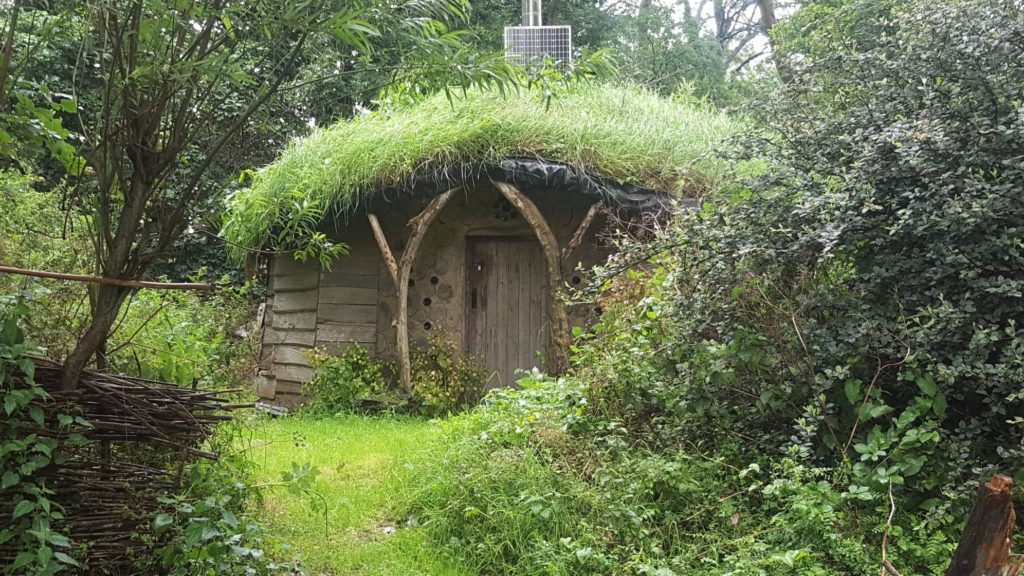
The beautiful round house which gives the location one of its many many charms
By the end of the four sessions you will have four beautiful drawings which you can frame and keep or gift! You will also be able to say they were drawn using charcoal you made yourself!
Each session is £20 and is open to anyone over the age of 12 and over. All materials will be provided.
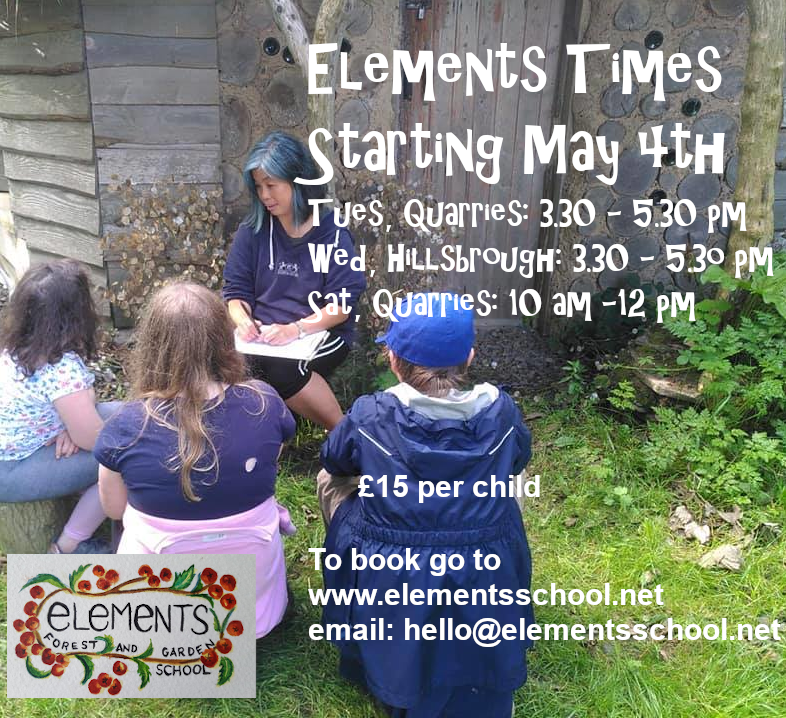
We are returning!!!! From 4th of May onwards. Book your sessions here!!! We are also having a special season – each session is now only £15! That’s two hours of outdoor summer fun for only £15!!! We are also having a Summer Scheme!! Watch this space for details!
We are returning!!!! From 4th of May onwards. Book your sessions here!!! We are also having a special season – each session is now only £15! That’s two hours of outdoor summer fun for only £15!!! We are also having a Summer Scheme!! Watch this space for details!
A birdbath will transform your feeding station into a bird spa.
We continue our series on making our gardens great for wildlife.
Water is really important at this time of the year. You may think that because we live in a wet place there is lots of water for birds available, but of course it is also really cold – especially this year – and birds will find puddles frozen and they cannot drink seawater so anything you put out for them is a huge plus.
The best thing to put out is a birdbath. Here are the important characteristics of a birdbath. It is so simple you will have one up in not time at all.
Shallow enough for birds to bathe in.
Clean water – rainwater is best, but if not, you can fill it from the garden tap.
Finally, not frozen. To defrost your birdbath, pour hot water into it every morning. DO NOT ON ANY ACCOUNT PUT IN ANTIFREEZE OR SALT. you can also float stick in the bath. This helps to keep the water moving and not get frozen, so they say. I just put the kettle on and do it as part of the morning ritual as I make coffee.
That’s it, sooooo easy.
You can use any contained or create a small pond using pond liner. My first birdbath was the old baby bath which was no longer used for the boys when they outgrew it. You can fill it with stones to decrease its depth. I also use old bowls, dishes, etc, as long as it is large enough for a bird to have a splash in.
Often people have birdbaths which are placed a little higher in a predator (cat) proof place, so the birds can have a peaceful bath.
Clean the bird bath regularly.
Enjoy watching your feathered friends enjoy themselves.
It is a great time of the year to start astronomy and having taught it to eleven and twelve year olds, I can tell you that children love the stars.
The constellations are a wonderful way for children to learn about history, maths, astronomy as well as mythology.
One of the simplest ways to start to know the constellations is to begin with a ‘charismatic’ on and there is no constellation more charismatic and more recognisable than Orion. Just before we go on, we are starting our Forest School sessions on 5 Jan.
To help you keep your new year’s resolutions to spend more time outdoors we have reduced our Jan/Feb prices to £15 per session for each child.
If you would like to take advantage of this offer, please contact us at hello@elementsschool.net
Back to Orion! Visible in the skies from around 8 pm at night, it ‘rises’ till quite late and you can track it all the way across the skies till bedtime.
Locate Orion by looking for his ‘belt’ – which are the three stars in a straight line. Orion was such a distinctive constellation that even in the ancient past, our Babylonian astronomers – we follow the Babylonian tradition – already spotted him. And all the starts in Orion have Arabic names. The three stars are called Alnitak, Alnilam and Mintaka. However the two biggest stars, literally are Betelgeuse and Rigel. Betelgeuse is actually orange in colour, as a star you can see that, and Rigel is blue.
GO OUTSIDE NOW – OR LATER THIS EVENING – TO LOOK AT ORION.
How can you help your child to start to map the stars?
You can get a star chart or map – or better still download an app on it.
Locate Orion on it. Then do the same in the night sky.
Then get some black paper and a white colour pencil and draw Orion out in it. You could even learn the Greek alphabet using it. Each major star has its own Greek alphabet in order of precedence.
Here is the story of Orion, the Great Hunter. You can tell the story of Orion while looking at the constellation or drawing it on paper.
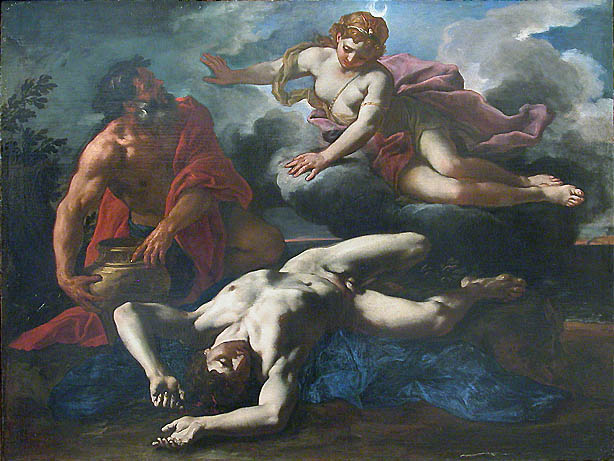
Orion was likely the son of the sea-god Poseidon and Euryale, daughter of Minos, King of Crete. Orion could walk on the waves because of his father; he walked to the island of Chios where he got drunk and attacked Merope, daughter of Oenopion, the ruler there. In vengeance, Oenopion blinded Orion and drove him away. Orion stumbled to Lemnos where Hephaestus—the smith-god—had his forge. Hephaestus told his servant, Cedalion, to guide Orion to the uttermost East where Helios, the Sun, healed him; Orion carried Cedalion around on his shoulders. Orion returned to Chios to punish Oenopion, but the king hid away underground and escaped Orion’s wrath. Orion’s next journey took him to Crete where he hunted with the goddess Artemis and her mother Leto, and in the course of the hunt, threatened to kill every beast on Earth. Mother Earth (Apollo in some versions, disapproving of his sister’s relationship with a male) objected and sent a giant scorpion to kill Orion. The creature succeeded, and after his death, the goddesses asked Zeus to place Orion among the constellations. Zeus consented and, as a memorial to the hero’s death, added the Scorpion to the heavens as well.
Finally locate Sirius, the Dog Star. I’ll write about Sirius tomorrow!
Happy stargazing!!!!
Diana mourns Orion – before immortalising him in the constellations
This article was written by me, Stephanie Sim. I worked in the RSPB for ten years and have worked as a Steiner teacher for almost nine. Together with Jonathan McMurray we both have almost 20 years of educational and forest school experience between us. If you are interested in finding out more about the Forest School sessions we run for your child/ren, school, organisation or club, please contact us at hello@elementsschool.net
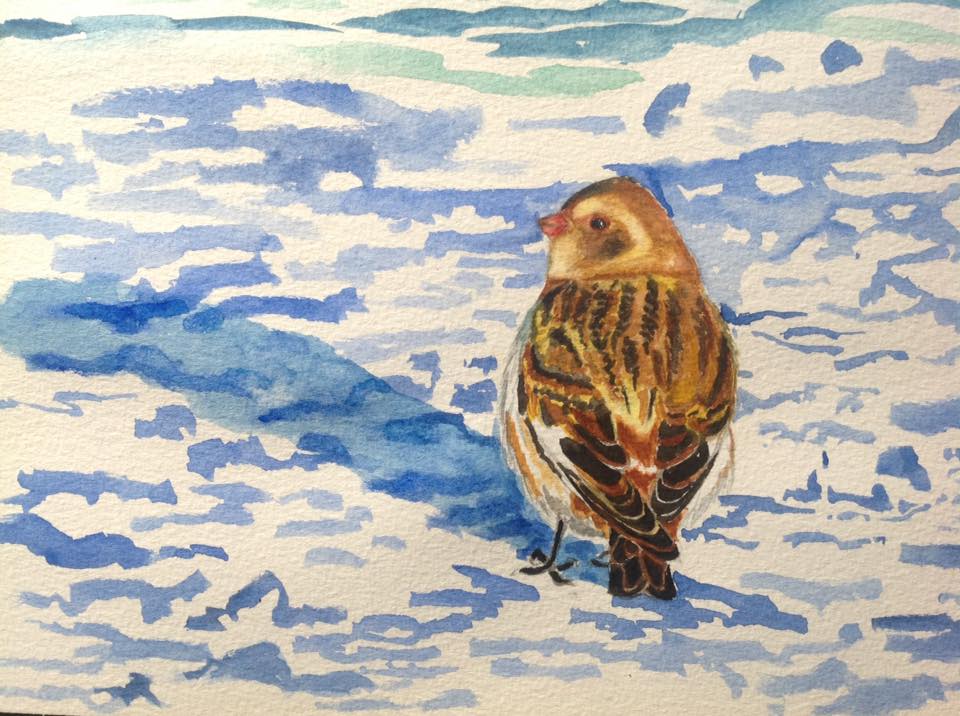
Snow bunting, photo by Anthony McGeehan, painting by Stephanie Sim
It is a tough time of year for anyone. Our wildlife friends have found it more and more difficult over the passing years as fields are gleaned for every seen and hedge thrashers remove any sustenance from the edges. Urban gardens are increasingly oases for animals to survive over the winter as the very forests are also decimated to be replaced by coniferous plantations which don’t do any awful lot for biodiversity.
So you want to help… what can you do? Even if you have a very very small garden or no garden at all, here are some simple things which won’t cost you a lot of £££. Remember that once you start KEEP GOING. Don’t disappoint the animals who have come to rely on you.
Leftovers:
Fruit which is about to go off or which has been sitting in your bowl for an overly long time is a good offering. Share apples, pears and berries. I’ve heard that birds are partial to watermelon as well!!!
You may cut them in half or just chuck them out. Thrushes are mad for them. You could have blackbirds, fieldfares, redwings and song as well as mistle thrushes flocking to you garden.
Breadcrumbs and scraps of cake, etc are also good. If you have a birdtable so much the better. You can make one as a gift for a friend or as a gift for the wildlife in your garden. You could also just SET UP a birdtable. All you need is a tallish structure which is rat proof (think plastic), and a little flat surface. Take your bits of cheese and bread from your breakfast table and put them there. You can also buy bird food for birds which find it hard to hang off feeders like blackbirds and robins
2. Birdfeeders
This is the most ubiquitous image of wildlife care. If I have any advise to give you regarding beginner level bird feeding, it is the following:
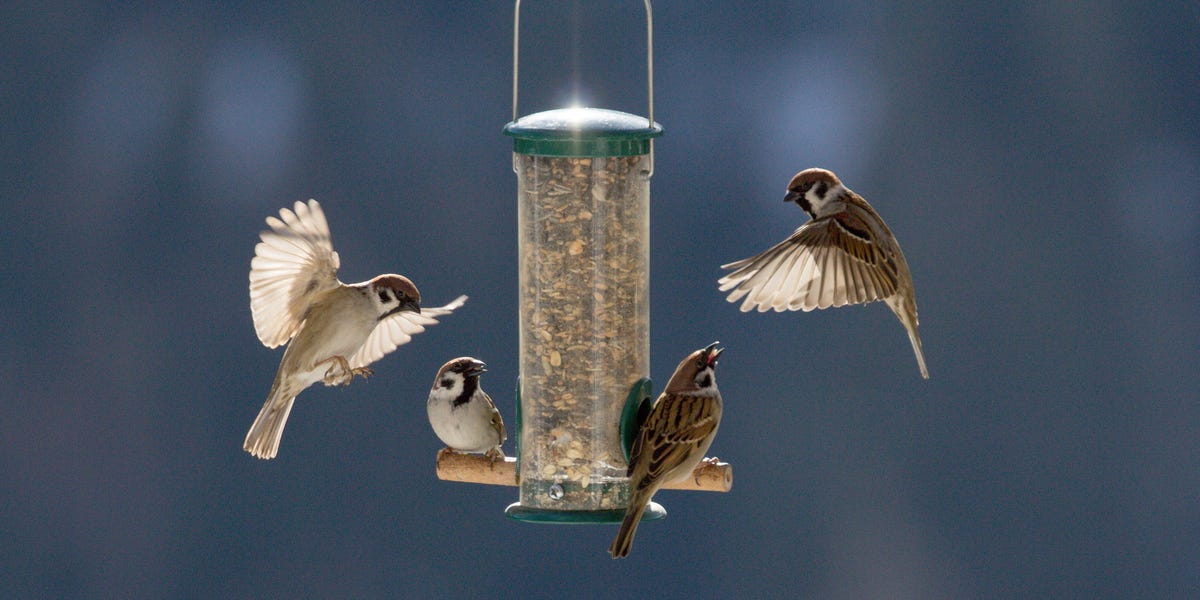
a. A simple feeder is just as good as a fancy feeder. Birds have no idea what you paid for the feeder. Just get a simple one if you are starting off. You can get a peanut feeder and a seed feeder. The above is a seed feeder. A peanut feeder looks like this.
b. The important thing about feeders is that you must keep them CLEAN. So a simple feeder is much better than a fancy feeder. Please resist the tempation to buy a fancy one until you have found your birdfeeding groove.
Wash them every two weeks with a bottle brush, just hot water and the brush. No need for soap, etc. If you don’t keep them clean they become ground for breeding the botulism bacteria especially in the summer. Birds that die from the botulism bacteria die slow painful deaths as their organs shut down. So wash your feeders. (Incidentally it is also the same bacteria which is used in botox. So, now you know.)
c. A bird table is a good idea if you want to feed birds that cannot cling to feeders – anything which isn’t a tit or finch. Robins can just about do this. But anything else, apart from the acrobatic jay and enterprising squirrel will be unable to use a feeder.
2. Feed
And now the vexing question of feed. There is no two ways about it, if you are putting out 5 kg of feed a day the birds will eat 5 kg of feed, so don’t try and keep up with them or you will be very broke. There is a reason why sparrows were considered vermin (actually, criminally, they still are.)
Put out what you can but do it daily.
Here are some other top tips:
a. Do not, and I repeat NOT, buy birdfood with wheat it in. It a waste of time and money, unless you are planning to grow wheatfield in your garden. The birds will either poop it out or just throw it out. I spent many an amusing morning watching the tits chuck out the wheat grains and just take the other seeds. Also the rats wait under feeders for their wheatfeed.
b. Sunflower seeds, mealworms, etc are all good. All birds love this. You can also get them fatballs and bird ‘cake’.
c. Nyger seeds are the next level of birdfeeding. Only get this if you have goldfinches in your garden. They will need their own biredfeeder.
3. Where to set it up
For the best out of your birdfeeder do the following:-
a. Place your bird feeder at a convenient height so you can reach it to change it. Make sure your cat can’t get at it. So there should be good lines of sight for your birds. I have a cat btw, it has learned there is no point chasing the birds because they will be long gone by the time he gets there.
b. If you have a shrub like a buddleigh or a medium sized tree, this is quite good because the birds can skulk in the shrubbery until they feel safe enough.
c. Put the feeder near enough to a window so you can observe the birds. There are even feeders you can buy that ATTACH to windows. Watching them is the BEST THING EVER!!!!
d. Finally, be patient. It can take up to a week or more if birds don’t know about the feeder. It can take a while to establish itself. However, once it gets going they will be there everyday and if you don’t put food out they will come along and wait until you do!
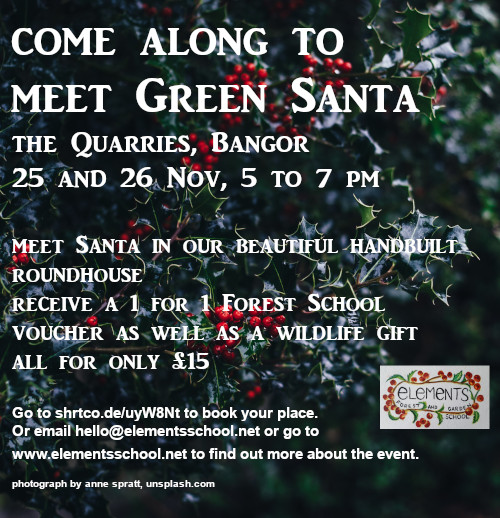
Why Green Santa? Well, Christmas is a Christian holiday which has been grafted over a solar reality – which is the winter solstice, the shortest day of the year. On this day the birth of the sun, or the return of the light, literally took place. All over the Northern Hemisphere, the festivals of light culminate the biggest light festival of all. After the 21st of December, the pendulum swings back to the long days of summer.
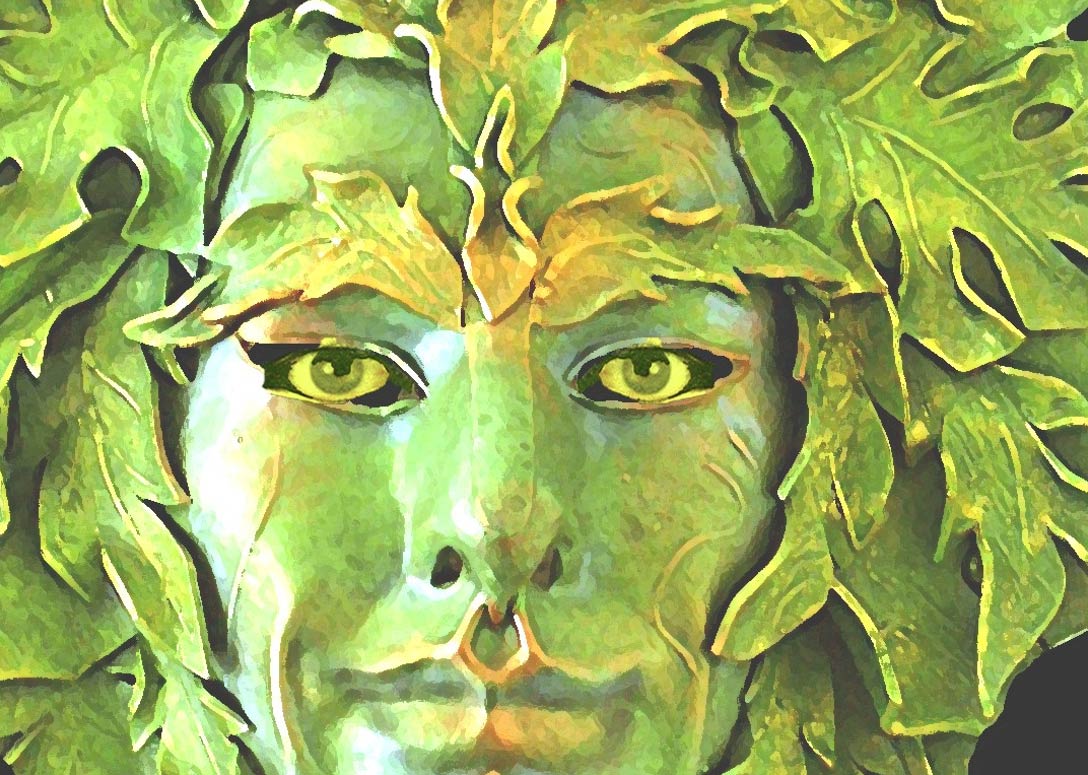
The ancient peoples of Ireland and these Isles celebrated this with the Green Man. At the heart of this image is one of the return of life, vegetation, the spring. Conversely it is also an image of the passing of time – the old must give way to the new, from death new life springs.
Elements is celebrating the solstice for the first time. Sadly we are unable to do this at the time we were hoping to – after Advent, but we thought we’d try to squeeze this in, just to bring some luck and glee into the start of the season.
So come along and mark the awaiting of the sun’s return with us. Hope to see you there.